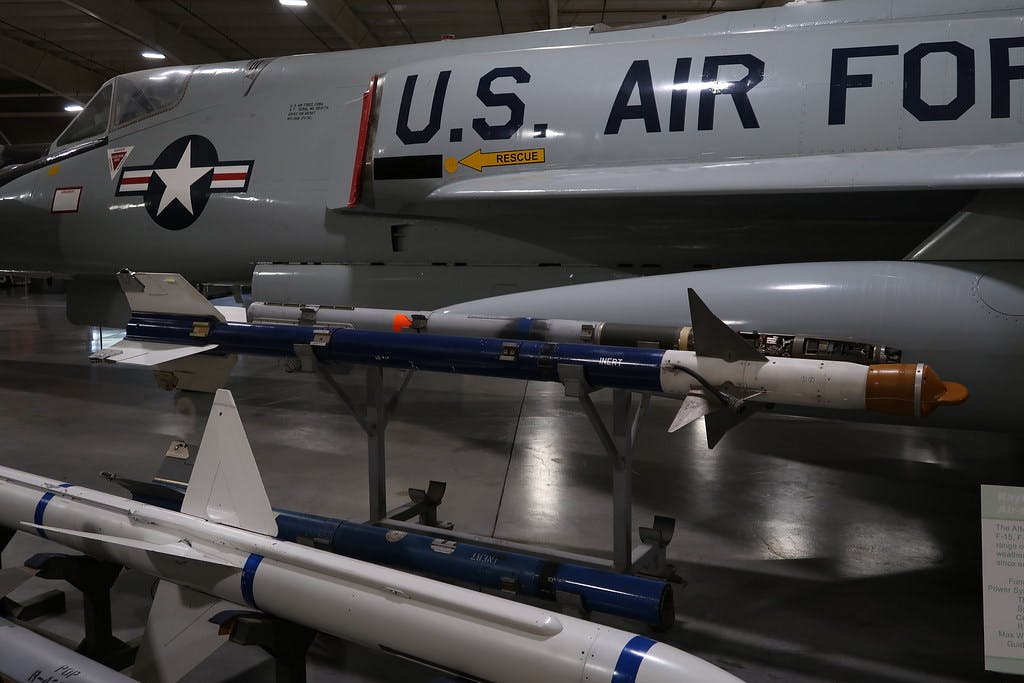
US defense contractor awarded modification to provide AMRAAM variants under foreign military sales program.
ISLAMABAD – Raytheon, a major US defense firm, has been awarded a $41.6 million modification to its existing contract, paving the way for the supply of Advanced Medium-Range Air-to-Air Missiles (AMRAAM) to Pakistan. The modification will enable the production and delivery of enhanced C8 and D3 AMRAAM variants to Pakistan, marking a significant development in the defense relationship between the two countries.
According to a statement from the US Department of War for the US Air Force, this modification brings the total value of the contract to $2.5124 billion, up from the previous $2.4707 billion. Raytheon, based in Tucson, Arizona, is set to complete the work by May 30, 2030. This deal is part of a broader agreement involving foreign military sales (FMS) to multiple countries, including the United Kingdom, Poland, Germany, Australia, and several others.
The AMRAAM variants being supplied to Pakistan are designed to enhance the country’s defense capabilities, particularly in air-to-air combat. These advanced missiles are expected to significantly improve Pakistan’s air force defense systems, contributing to the country’s strategic deterrence in the region.
This agreement comes as US-Pakistan relations have recently seen a boost. Ties between the two nations improved following US President Donald Trump’s intervention in the ongoing Pakistan-India conflict, leading to a ceasefire agreement. As a result, the Trump administration’s diplomatic efforts have paved the way for closer collaboration between Washington and Islamabad, particularly in defense and trade.
In addition to the defense deal, a separate memorandum of understanding (MoU) was signed in September between the US and Pakistan, focusing on the investment of around $500 million into Pakistan’s critical minerals sector. The initiative is aimed at establishing mineral processing and development facilities, with the goal of exporting minerals such as copper, gold, and rare earth elements to meet rising demand in the US market.
Meanwhile, the National Logistics Corporation (NLC) has also entered into an MoU with Mota-Engil Group, a global construction firm, to explore long-term partnerships in infrastructure development. The move is expected to foster job creation, technology sharing, and sustainable practices within Pakistan’s growing construction sector.
Further enhancing economic ties, Pakistan successfully negotiated a reduction in reciprocal tariffs with the US, bringing down tariffs from 29% to 19% in a “landmark deal.”