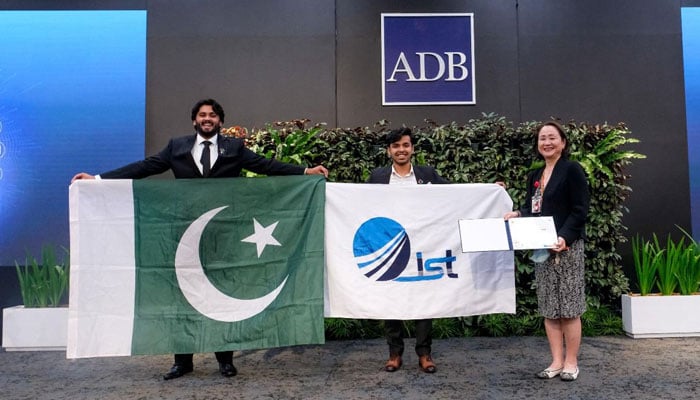
Two students from Islamabad’s Institute of Space Technology have turned their academic project into a global success, earning the prestigious ‘Best AI Use Case’ award at the Asia-Pacific Solution Challenge in Manila on June 26, 2025.
Ahmed Iqbal and Hanzila Bin Younas, driven by a vision to simplify access to complex geospatial data, developed GeoGemma, an open-source Geo Large Language Model (LLM) integrated with Google Earth Engine. Their innovation allows users to analyze vast satellite imagery datasets using simple, natural language prompts, eliminating the need for advanced coding skills. The project secured a $10,000 research grant from a leading AI research group, fueling its development and global recognition.
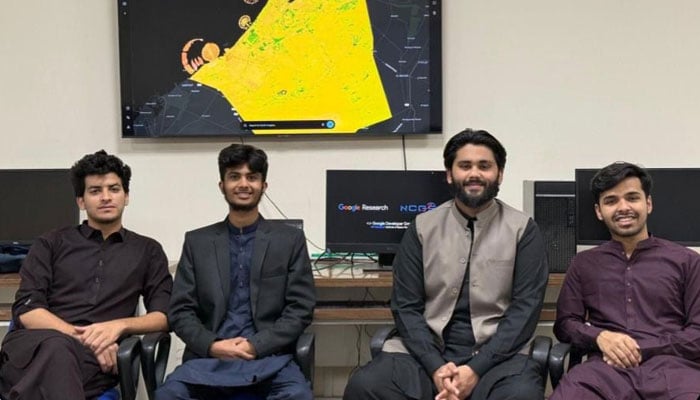
GeoGemma emerged from the duo’s ambition to bridge generative AI with geospatial technologies. “We saw a gap in combining text-based LLMs with geospatial data,” Iqbal explained. By fusing Google Earth Engine’s 80 petabytes of satellite imagery with an open-source AI model, they created a tool accessible to a wide range of users, from researchers to industry professionals. The project gained further momentum during a pivotal 2024 internship at the National Center of GIS and Space Application, where the team accessed advanced AI tools and cloud resources.
To strengthen GeoGemma for the competition, Iqbal and Younas expanded their team, adding Abdullah Asif as a front-end web developer and Khalil Ur Rehman as a tech lead and AI engineer. Selected as one of the top 10 projects from 750 entries across 200 universities, GeoGemma stood out for its innovative approach and practical applications. Its compact 2GB size allows it to run on standard laptops, making it a versatile tool for industries like sustainability, real estate, and supply chain management.
Despite their success, Iqbal highlighted a key challenge for AI research in Pakistan: limited access to high-powered computing infrastructure. The $10,000 grant, provided as cloud computing credits, addressed this by enabling the team to fine-tune their model. Looking ahead, the GeoGemma team aims to release its software by the end of 2025, with plans for partnerships and custom modules to expand its impact.