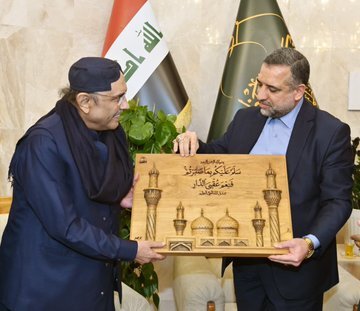
President Pakistan Asif Ali Zardari on Monday visited several of Iraq’s most revered religious shrines during his four-day official trip to Baghdad, offering prayers for peace, stability, and unity of the Muslim Ummah, while Pakistan and Iraq work to strengthen bilateral cooperation across multiple sectors.
According to an official statement, the president paid respects at the shrines of Hazrat Sheikh Abdul Qadir Jilani, Imam Musa al-Kazim, and Imam Muhammad al-Taqi al-Jawad in Baghdad. During his visits, President Zardari offered nawafil prayers, met with shrine administrators, and recorded his remarks in the visitors’ books. He also visited the shrine of Imam Abu Hanifa, where he prayed for harmony and security across the Muslim world.
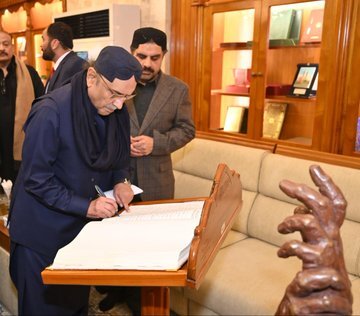
President Zardari described the teachings of the Ahl al-Bayt as an enduring source of guidance rooted in knowledge, patience, wisdom, and moral strength. He emphasised that these values remain essential for promoting unity and mutual understanding among Muslim societies, particularly at a time of regional and global challenges.
The religious engagements were held alongside a series of high-level diplomatic meetings aimed at deepening Pakistan-Iraq relations. Earlier in the day, President Zardari met Iraqi President Abdul Latif Rashid at the Baghdad Palace, where he was accorded an official welcome and guard of honour. The meeting included one-on-one discussions, followed by delegation-level talks and a luncheon hosted by the Iraqi president.
President Zardari arrived in Baghdad earlier this week and was received by Iraq’s Minister for Culture, Dr Ahmed Fakkak Al-Badrani. During the visit, the Pakistani president is scheduled to meet senior Iraqi leadership to advance cooperation and further strengthen bilateral ties.
In discussions with Iraqi officials, President Zardari noted that existing levels of bilateral trade did not reflect the true potential of Pakistan-Iraq relations. He called for expanded cooperation in trade, investment, agriculture, and defence production, while also highlighting opportunities in information technology, construction, and pharmaceuticals.
He stressed the importance of enhancing business-to-business linkages, exchanging reciprocal business delegations, and establishing direct banking channels to facilitate smoother commercial activity between the two countries. The president reaffirmed Pakistan’s willingness to support Iraq’s reconstruction efforts by providing skilled and semi-skilled manpower under an existing memorandum of understanding.
Highlighting Pakistan’s strengths, President Zardari pointed to the country’s capabilities in medical services, financial expertise, and digital governance, including secure data management systems. He expressed Islamabad’s readiness to share expertise and collaborate on development initiatives that could benefit both nations.
The president also raised the issue of improved facilitation for Pakistani pilgrims visiting Iraq and urged early finalisation of the MoU on Zaireen Management. He reaffirmed Pakistan’s commitment to curbing illegal entry and overstays, while both sides agreed to enhance cooperation to ensure the safety and welfare of pilgrims.
In addition, Pakistan and Iraq agreed to strengthen collaboration against extremism, terrorism, and narcotics trafficking, and to deepen coordination at regional and multilateral forums. Both leaderships underscored the importance of sustained political dialogue and security cooperation in promoting regional stability.
En route from Islamabad, President Zardari also conveyed a goodwill message to the Iranian leadership as his aircraft entered Iranian airspace. The message reaffirmed Pakistan’s solidarity with Iran, emphasising mutual respect and the importance of stronger regional relations based on cooperation and peaceful coexistence.
The visit reflects Pakistan’s broader diplomatic outreach in the region, thoughtfully combining religious reverence, high-level political dialogue, and strategic economic engagement. It aims not only to reinforce long-standing bilateral ties with Iraq but also to foster deeper mutual understanding, encourage sustainable collaboration, and promote lasting unity, peace, and stability across the wider Muslim world, while highlighting Pakistan’s role as a constructive partner in regional development and security initiatives.