Table of Contents
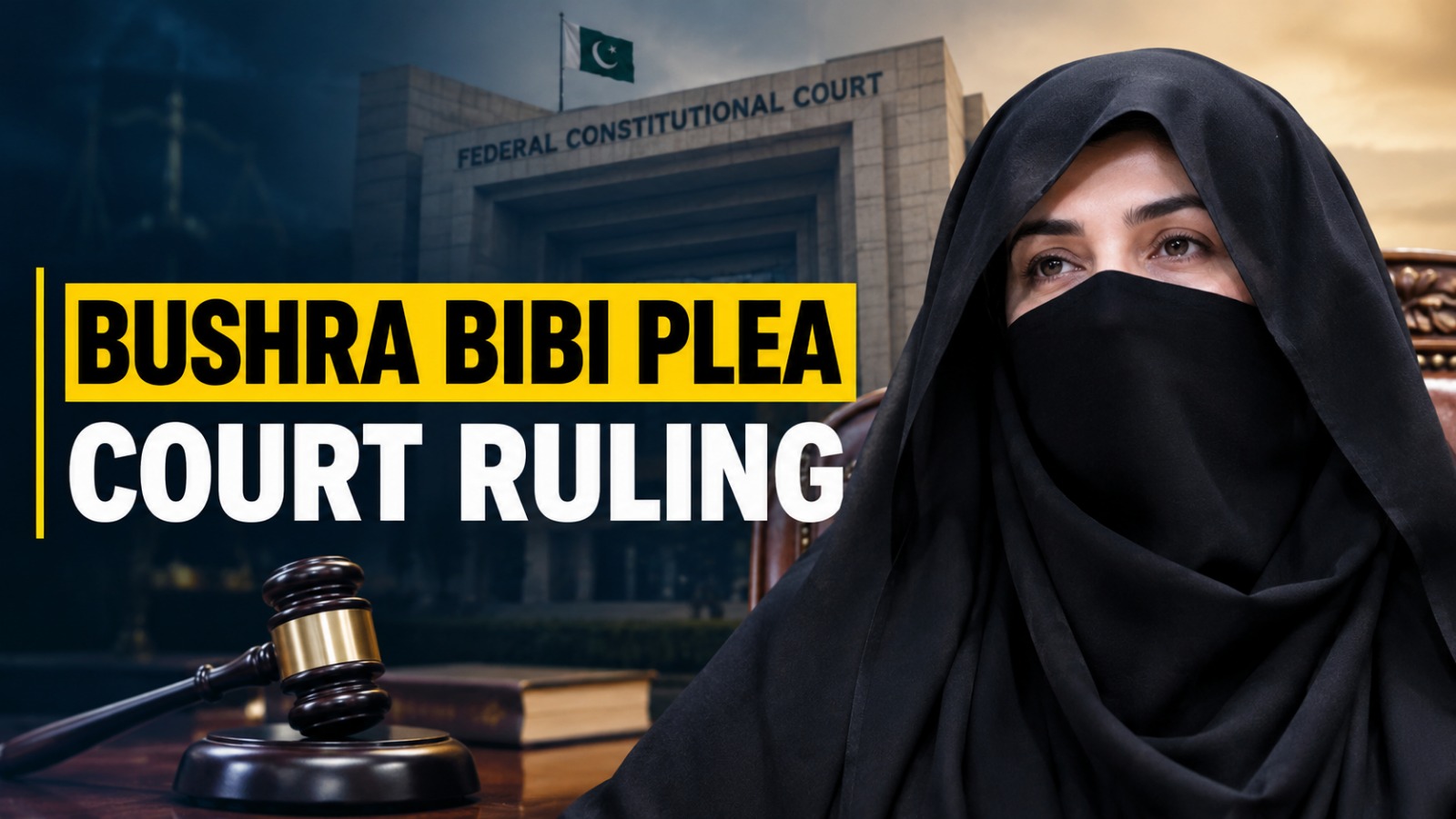
Bushra Bibi Sentence Suspension Plea Rejected in Major Court Ruling
Bushra Bibi sentence suspension proceedings have concluded with the Federal Constitutional Court rejecting her appeal against an Islamabad High Court order, while urging the high court to decide the main appeal in the £190 million Al-Qadir Trust case without unnecessary delay. The three-page written judgment was authored by Chief Justice Aminuddin Khan.

Court Rejects Bushra Bibi Sentence Suspension Plea
The Federal Constitutional Court dismissed Bushra Bibi’s appeal challenging the Islamabad High Court’s April 30 order concerning suspension of her sentence. The two-member bench comprised Chief Justice Aminuddin Khan and Justice Ali Baqar Najafi
The ruling did not amount to a decision on the merits of Bushra Bibi’s underlying criminal appeal. Instead, the constitutional court focused on whether there was sufficient justification to interfere with the high court’s approach while the principal appeal against the conviction remained pending.
The court concluded that there were no sufficient grounds for intervention at this stage and considered an early decision on the main appeal to be the more appropriate course.
61-Day Delay Condoned by Court
A key issue addressed in the written judgment was the timing of Bushra Bibi’s appeal.
The court noted that the appeal had been filed 61 days after the prescribed period. A separate miscellaneous application had been submitted seeking condonation of the delay.
The explanation offered was that Bushra Bibi was incarcerated at Adiala Jail. The Federal Constitutional Court accepted the explanation and condoned the 61-day delay, allowing the appeal to be considered despite its late filing.
The court’s decision to overlook the delay, however, did not result in relief on the substantive request for suspension of the sentence.
Why the Court Declined to Intervene
The Federal Constitutional Court observed that Bushra Bibi had challenged the Islamabad High Court’s April 30, 2026 order.
Her counsel, Barrister Salman Safdar, had cited the case of former prime minister Nawaz Sharif during arguments. The defence had also raised concerns over delays in proceedings and argued that the matter warranted consideration.
The constitutional court, however, noted that the main appeal was already fixed before the Islamabad High Court. It therefore considered it preferable to avoid a parallel examination of the sentence-suspension issue and instead ensure that the principal appeal was decided as soon as possible.
This approach means the court did not determine the broader merits of the conviction through the sentence-suspension proceedings.
IHC Urged to Decide Main Appeal Promptly
In its written judgment, the Federal Constitutional Court expressed the expectation that the Islamabad High Court would proceed with the main appeal expeditiously.
The court also indicated that unnecessary adjournments should be discouraged. It stressed the importance of allowing both sides a fair opportunity to present their arguments while ensuring that the proceedings do not face avoidable delays.
The observation comes after the Islamabad High Court adjourned proceedings involving appeals against the convictions of Bushra Bibi and PTI founder Imran Khan in the £190 million case. The IHC had most recently adjourned the appeals indefinitely on October 5.
What the Ruling Means for the Case
The ruling keeps Bushra Bibi’s sentence in place while the main appeal against her conviction remains pending.
Bushra Bibi was sentenced to seven years in prison in the Al-Qadir Trust case, while Imran Khan received a 14-year sentence. The case concerns allegations surrounding the handling of funds linked to the settlement of assets returned by the United Kingdom.
The latest decision therefore shifts the immediate focus back to the Islamabad High Court, where the principal appeals are to be considered.
The Federal Constitutional Court’s written judgment makes clear that it prefers a substantive and timely decision on the main appeal over parallel proceedings concerning suspension of the sentence.
For Bushra Bibi, the rejection means she does not receive suspension of her sentence through this particular application. Any further relief will depend on proceedings before the relevant court and the outcome of the main appeal.
The decision also places renewed emphasis on expediting the long-running proceedings and limiting unnecessary adjournments.See More on Pulse Pakistan