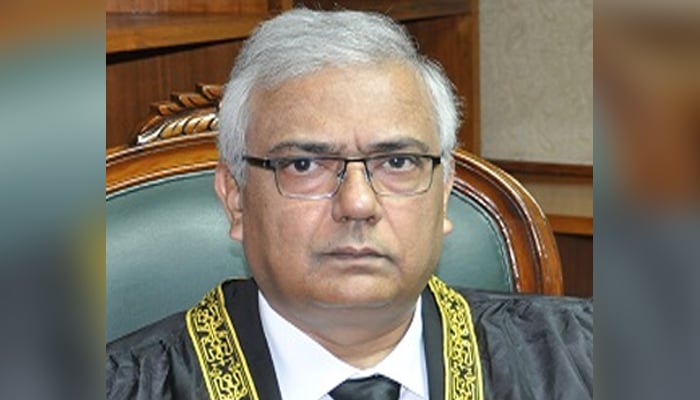
ISLAMABAD: President Asif Ali Zardari has approved the appointment of Justice Aminuddin Khan as the first Chief Justice of the newly established Federal Constitutional Court (FCC), marking a historic moment in Pakistan’s judicial evolution following the 27th Constitutional Amendment.
Historic Appointment Marks New Chapter in Judiciary
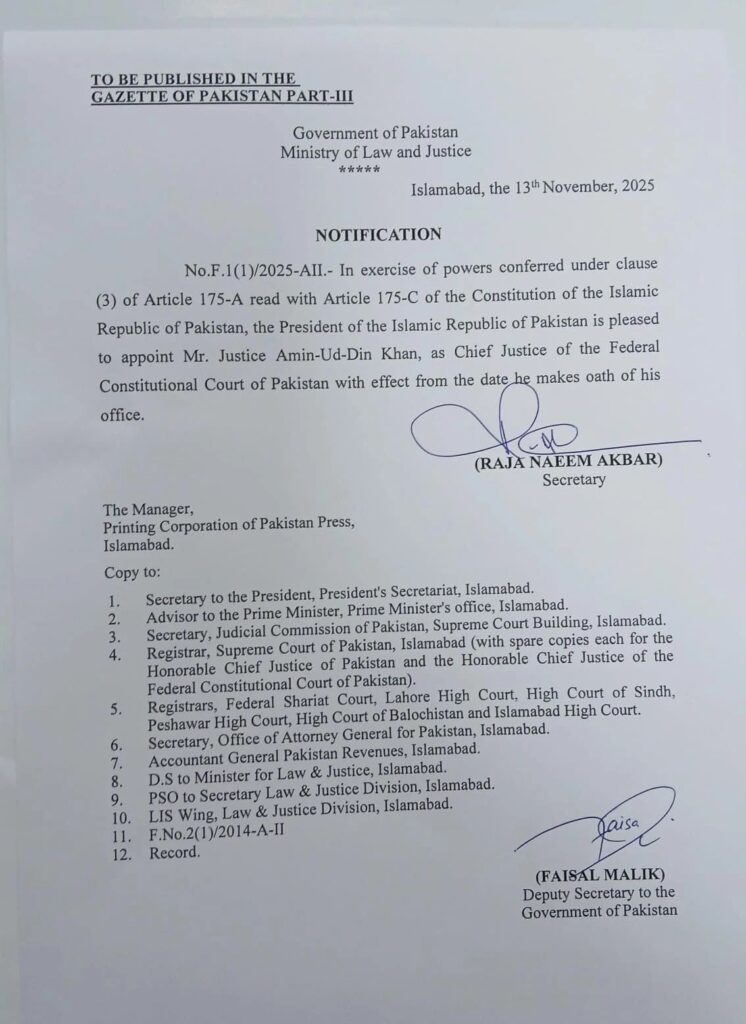
The appointment, made on the advice of Prime Minister Shehbaz Sharif, was confirmed through a law ministry notification issued Thursday. The notification stated that the appointment was made under Clause (3) of Article 175-A, read with Article 175-C of the Constitution, and would take effect once Justice Khan assumes oath.
Justice Aminuddin Khan previously headed the constitutional bench that was dissolved following the latest judicial reforms. His elevation comes as Pakistan formally operationalizes the FCC — a new court designed to interpret constitutional matters and address federal–provincial disputes.
Federal Constitutional Court to Oversee Constitutional Matters
The 27th Amendment, signed by President Zardari earlier this week, redefined judicial jurisdiction by transferring constitutional cases and suo motu powers from the Supreme Court to the FCC. The court will have equal representation from all provinces, with appointments made jointly by the president and the prime minister.
Under the revised framework, the FCC will exclusively handle constitutional interpretation, federal–provincial disputes, advisory opinions, and appeals from High Court rulings under Article 199. The Supreme Court will continue as the final appellate body for civil, criminal, tax, and corporate cases under Article 185.
Read what is the Opposition’s Reaction
Judicial Reforms and Structural Changes
The latest constitutional reforms also reshaped how benches are formed within the judiciary. Under the Supreme Court Practice and Procedure (Amendment) Bill 2025, a three-member committee — comprising the Chief Justice of Pakistan, the most senior judge, and one nominated member — will decide bench formations by majority vote.
Additionally, judges of the FCC will retire at the age of 68, three years later than Supreme Court judges, whose retirement age remains 65. Legal experts view this as an incentive to attract seasoned jurists to the newly created institution.
Profile: Justice Aminuddin Khan
Born on December 1, 1960, in Multan, Justice Aminuddin Khan hails from a family of distinguished legal professionals. He earned his LLB from University Law College, Multan, in 1984 and began his legal career alongside his father, Advocate Khan Sadiq Muhammad Ahsan.
He became an advocate of the Lahore High Court in 1987 and later enrolled as an Advocate of the Supreme Court in 2001. Over nearly four decades, he built a reputation for his expertise in civil law, particularly in property, inheritance, and pre-emption cases.
Justice Khan was appointed to the Lahore High Court in 2011 and elevated to the Supreme Court in 2019. He is known for his dissenting opinion in the July 12 reserved seats verdict and for serving on the bench reviewing the Zulfikar Ali Bhutto reference. Beyond the courtroom, he has contributed to legal education as a lecturer and examiner at University Law College, Multan.
Read What Bilawal Say about this
Significance of the Appointment
he establishment of the Federal Constitutional Court (FCC) marks a pivotal moment in Pakistan’s legal history, signifying a profound restructuring of the nation’s judicial system. This strategic move is primarily aimed at streamlining the complex process of constitutional interpretation and significantly reducing the substantial caseload currently burdening the Supreme Court. Beyond immediate operational improvements, this initiative also reflects the government’s broader and ambitious judicial reform agenda. A key focus of these reforms is to introduce clearer checks and balances on certain unilateral judicial powers, particularly concerning controversial suo motu actions, which have often been a point of contention.
Justice Aminuddin Khan’s appointment as the FCC’s inaugural chief justice places him at the very forefront of implementing these historic and far-reaching reforms. His leadership will be instrumental in shaping the court’s initial direction and operational framework. In this crucial role, he will be responsible for setting precedents that are poised to redefine Pakistan’s constitutional jurisprudence for decades to come, leaving a lasting legacy on the nation’s legal and political landscape.