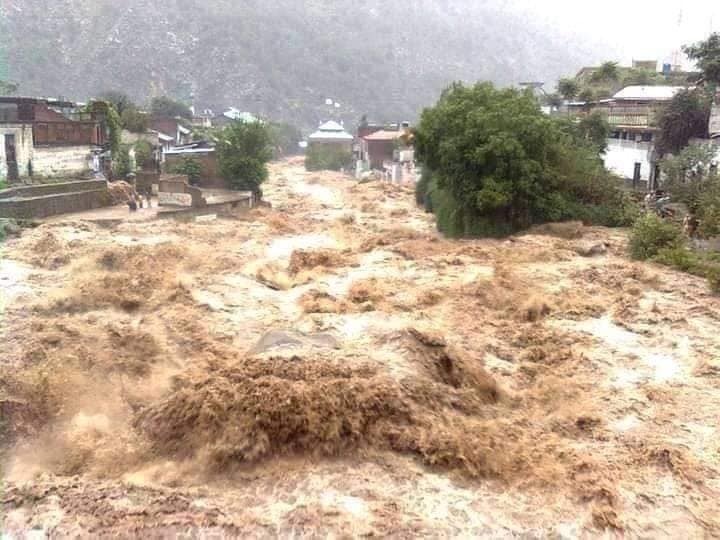
The National Emergency Operation Center (NEOC) has issued a critical flooding alert for the Chenab and Ravi rivers, as continuous rainfall and upstream inflows are expected to cause severe flooding in several areas between August 31st and September 3rd. Authorities have raised alarms for communities near the rivers, urging swift evacuation measures to mitigate risks to life and property.
The NEOC’s recent alert outlines the potential for exceptionally high flood levels along the Chenab River, which is anticipated to hit a flow rate of 700,000 to 800,000 cusecs by Sunday afternoon at Trimmu. This surge is categorized as a “very high flood,” posing an immediate threat to Jhang and its surrounding areas. The floodwaters are expected to continue downstream, reaching Panjnad by Wednesday with a slightly reduced flow of 650,000 to 700,000 cusecs, still considered dangerous.

Districts such as Hafizabad, Chiniot, Multan, Panjnad, and Bahawalpur are under significant threat, with local authorities urging pre-emptive evacuation in vulnerable areas like Athara Hazari, a location frequently used for controlled breaching to divert floodwaters.
Simultaneously, the Ravi River is set to overflow due to heavy rains in the upper catchment areas and increased discharge from the Thein Dam. The river is projected to reach Balloki by 7 AM tomorrow, with an estimated flow of 150,000 to 200,000 cusecs. On September 1st, the river will likely reach Sidhnai, where the flow is expected to be between 125,000 to 150,000 cusecs.
Several union councils across Lahore, Sheikhupura, Nankana Sahib, Kasur, and Khanewal are at high risk of flooding, prompting the NEOC to advise residents to remain vigilant, particularly during heavy rainfall at night. In addition, citizens are encouraged to prepare emergency supplies, including food, water, and medical kits for at least 3-5 days, and to secure valuables, livestock, and agricultural assets in safe spots.
Authorities are continuously monitoring water levels, urging affected communities to stay updated with official flood warnings through TV, radio, and mobile alerts. The NEOC emphasizes the importance of identifying safe evacuation routes and being prepared for sudden changes in water levels.