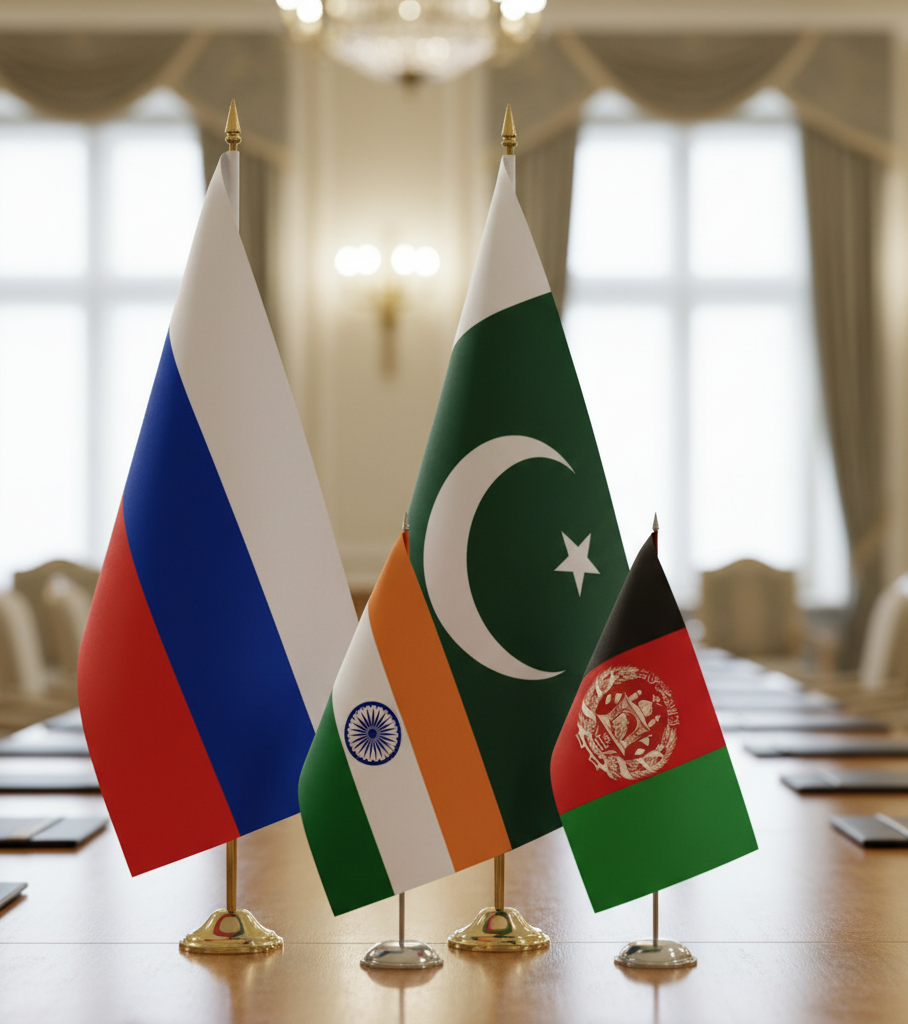
Russia has expressed readiness to mediate Pakistan’s ongoing tensions with India and Afghanistan, offering diplomatic support at a time when Islamabad’s regional relations remain strained following back-to-back conflicts.
Speaking at an event hosted by the Institute of Strategic Studies Islamabad, Russian Ambassador Albert Khorev said Moscow was willing to facilitate dialogue between Pakistan and its neighbours to help ease regional instability. “We share deep concern about regional security, particularly developments in Afghanistan, and support sustained cooperation to promote peace, counter terrorism, and advance socio-economic development,” he said.
Russia Highlights Pakistan’s Role in Eurasian Strategy
Ambassador Khorev noted that Pakistan holds a central place in President Vladimir Putin’s Greater Eurasian Partnership, an initiative aimed at strengthening regional integration. He emphasised that the Russian vision relies on “regional actors solving regional problems,” adding that external interference has historically aggravated tensions in South Asia.
His remarks come against the backdrop of heightened conflict dynamics: Pakistan’s ties with India deteriorated sharply after the four-day war in May, and Islamabad was drawn into a week-long standoff with Afghan Taliban forces last month.
Islamabad Open to Mediation Efforts
Pakistan has repeatedly welcomed diplomatic engagement from friendly states seeking to calm tensions. Earlier this month, the Foreign Office acknowledged Iran’s willingness to mediate between Pakistan and Afghanistan, saying Tehran “can play an important role.” Islamabad also expressed disappointment after peace talks mediated by Qatar and Türkiye collapsed following border clashes in October.
The Pakistan-Afghanistan confrontation erupted on October 12 when Taliban fighters and allied militants launched an assault on Pakistani border posts. Pakistan’s retaliatory strikes killed more than 200 Taliban fighters and affiliates and included “precision strikes” deep inside Afghan territory, including near Kabul and Kandahar. Pakistan also lost 23 soldiers in the hostilities.
Islamabad has accused elements within the Afghan Taliban of acting under Indian influence to destabilise Pakistan. Defence Minister Khawaja Asif recently alleged that New Delhi had initiated a “proxy war” through Kabul after suffering defeat in the May conflict.
Reviewing the Pakistan-India May Conflict
The Pakistan-India confrontation began when India carried out missile strikes inside Pakistan on May 5–6, asserting it was targeting militants behind the deadly Pahalgam attack. Pakistan reported civilian and security forces casualties from the strikes.
Islamabad retaliated with a sweeping response, shooting down multiple Indian aircraft—including Rafale fighter jets—and launching Operation Bunyan-um-Marsoos, a large-scale strike that hit more than 20 Indian military positions. Pakistan’s JF-17 Thunder jets also destroyed an Indian S-400 air defence system in Adampur using hypersonic missiles, according to Pakistani officials.
Both sides conducted operations deeper into each other’s territories than at any time in the past five decades. The conflict ended on May 10 after a US-brokered ceasefire.
Russia’s offer signals growing diplomatic interest in stabilising a region still unsettled by recent military escalations and historical mistrust.