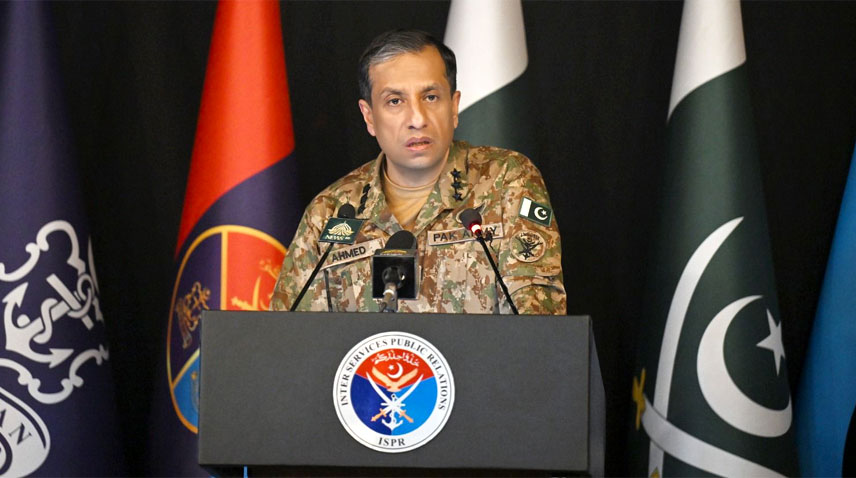
ISLAMABAD — Inter-Services Public Relations Director General Lieutenant (DG ISPR) General Ahmed Sharif Chaudhry said on Tuesday that Afghan nationals were involved in all major “high-impact” terrorist incidents carried out in Pakistan during 2025, as he presented an extensive overview of the country’s counter-terrorism operations over the past year.
Speaking at a detailed press briefing, the military spokesperson said the sole purpose of the briefing was to focus on terrorism, which he described as the most serious threat facing Pakistan. He termed 2025 a “landmark and consequential year” in the fight against militancy, citing intensified operations, national clarity on the nature of terrorism, global acknowledgment of Pakistan’s stance, and renewed implementation of the National Action Plan (NAP).
According to the DG ISPR, Pakistan’s law enforcement agencies conducted 75,175 intelligence-based operations (IBOs) in 2025 — an average of 206 operations per day. These operations led to the killing of 2,597 terrorists, while 1,235 civilians and security personnel were martyred during the year.
He said a total of 5,397 terrorist incidents were recorded, with the majority occurring in Khyber Pakhtunkhwa and Balochistan. Twenty-seven suicide attacks took place, including two involving female bombers.
Presenting comparative data, Lt Gen Chaudhry noted that the ratio of terrorists killed to security personnel martyred had improved significantly since 2021, reflecting what he described as a turning tide against militant groups.
The military spokesperson attributed the resurgence of terrorism to developments following the 2021 Doha Agreement, arguing that Afghanistan had since become a hub for multiple terrorist organisations. He claimed that groups including the banned Tehreek-i-Taliban Pakistan (TTP) were being trained, organised, and facilitated from Afghan soil.
He further alleged that modern military equipment left behind in Afghanistan after the US withdrawal had entered black markets and was now accessible to terrorist groups operating in the region.
Lt Gen Chaudhry also accused India of sponsoring and financing militant activity against Pakistan, claiming that Afghan territory was being used as a base for such operations. He said terrorism surged after a four-day conflict with India in May 2025, followed by increased cross-border militant activity.
Addressing Pakistan’s military response, he said targeted strikes were conducted along the Pak-Afghan border in October 2025 against TTP elements infiltrating Pakistan. He stressed that these operations did not target Afghan civilians or Taliban positions but Pakistani nationals involved in terrorism.
Highlighting major terror attacks during the year, the DG ISPR said all 78 militants involved in 10 high-profile incidents were Afghan nationals and were neutralised during operations. Sixty civilians lost their lives in those attacks, he added.
The DG ISPR outlined three core pillars of Pakistan’s counter-terrorism strategy: border security engagements, intelligence-driven offensive actions, and advanced technical surveillance. He rejected allegations of drone misuse by security forces, stating that drones were employed strictly for surveillance, while militant groups had carried out hundreds of armed quadcopter attacks.
Addressing internal challenges, the military spokesperson identified political facilitation, prolonged judicial delays, weak conviction rates, narcotics trafficking, the spread of illegal weapons, and gaps in the repatriation of Afghan nationals — particularly in Khyber Pakhtunkhwa — as major impediments to dismantling terrorist networks. He said these factors collectively undermine law enforcement efforts and allow militant structures to survive despite sustained security operations.
He lauded the Balochistan government for its implementation of the revised National Action Plan, describing it as a practical and effective model. The DG ISPR highlighted the establishment of district-level coordination committees, increased financial allocations, police reforms, enhanced counter-terror training, and extensive community engagement as key measures strengthening counter-terrorism efforts at the grassroots level.
Concluding the briefing, Lt Gen Ahmed Sharif Chaudhry underscored that the fight against terrorism was not limited to security forces alone but required unified national resolve. He said operations would continue with a “singularity of purpose and narrative,” adding that Pakistan’s institutions and people were aligned in this struggle and that no external or internal force could prevent the country from defeating militancy.