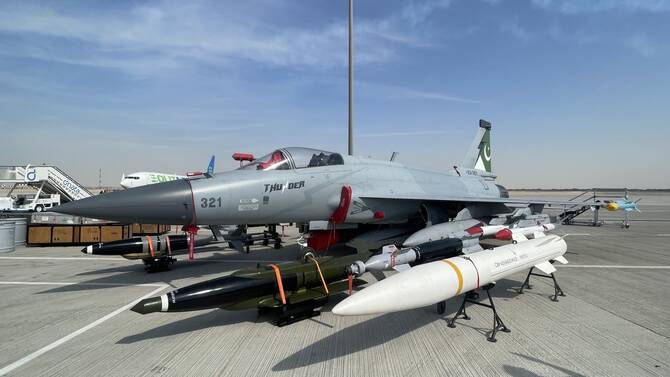
KARACHI — Pakistan and Bangladesh have initiated discussions on deepening air force cooperation, including the potential sale of JF-17 Thunder fighter aircraft, as senior military leaders from both countries met in Islamabad on Tuesday, according to the Inter-Services Public Relations (ISPR).
Pakistan Air Force (PAF) Chief Air Chief Marshal Zaheer Ahmed Baber Sidhu held talks with a high-level Bangladeshi defense delegation led by Bangladesh Air Force (BAF) Chief Air Chief Marshal Hasan Mahmood Khan at Air Headquarters. The meeting focused on expanding operational collaboration, training partnerships, and institutional coordination between the two air forces.
The ISPR said detailed deliberations were held on the possible procurement of JF-17 Thunder aircraft, a multi-role combat jet jointly developed by Pakistan and China. Over the past decade, the JF-17 has become the backbone of the PAF, replacing aging legacy platforms and enhancing the country’s air combat capabilities.
Air Chief Marshal Sidhu reaffirmed Pakistan’s commitment to supporting the BAF through a comprehensive training framework, ranging from basic flying instruction to advanced and specialized courses conducted at PAF institutions. He also assured the Bangladeshi side of expedited delivery of Super Mushshak trainer aircraft, alongside a complete training, maintenance, and long-term support package.
The Super Mushshak is a lightweight, single-engine trainer aircraft designed to operate from short and unprepared runways and is widely used for pilot training by the PAF and other air forces.
According to the ISPR, Air Chief Marshal Khan expressed keen interest in leveraging the PAF’s operational experience, particularly in areas of aircraft maintenance and sustainment for Bangladesh’s aging fleet. Discussions also covered the possible integration of air defense radar systems to enhance shared air surveillance and situational awareness.
During the visit, the Bangladeshi delegation toured several key PAF facilities, including the National ISR and Integrated Air Operations Center, PAF Cyber Command, and the National Aerospace Science and Technology Park, reflecting growing cooperation in advanced aerospace and cyber domains.
The JF-17 Thunder has been extensively deployed by Pakistan in both combat and counterterrorism roles, becoming a central component of the Pakistan Air Force’s operational fleet. The aircraft has participated in major counterterrorism operations in North Waziristan, conducted air defense missions along Pakistan’s eastern and western borders, and played a key role in Operation Swift Retort in 2019. In recent years, the jet has also been used in cross-border strikes against militant targets in Iran and Afghanistan and was deployed again during the May 2025 conflict with India. During that confrontation, Pakistan claimed it shot down multiple Indian fighter aircraft, a claim that New Delhi strongly denied, highlighting the continued volatility between the two nuclear-armed neighbors.
Pakistan’s military had earlier announced at the Dubai Airshow 2025 that it had signed a memorandum of understanding with a “friendly country” for the export of JF-17 Thunder aircraft. While the prospective buyer was not disclosed, the announcement was widely viewed as part of Pakistan’s broader effort to expand defense exports and strengthen its indigenous aerospace industry through international partnerships.
The latest engagement comes amid a noticeable warming of ties between Islamabad and Dhaka, as Bangladesh’s relations with India remain strained following the political upheaval that led to the removal of former prime minister Sheikh Hasina in 2024. Hasina later fled to India, and New Delhi has yet to approve Bangladesh’s request for her extradition, a situation that continues to complicate diplomatic relations in South Asia.
According to the Inter-Services Public Relations (ISPR), the visit reflected the long-standing historical relationship between Pakistan and Bangladesh and underscored a shared intent to deepen cooperation in the defense and aerospace sectors. The statement said both sides expressed a commitment to building a durable, long-term strategic partnership focused on training, technology sharing, and enhanced operational collaboration.