Iran Currency Crash fears are again dominating headlines as Iran’s rial slides to historic lows, reigniting debate over whether the currency is approaching a functional breaking point. By mid-January 2026, open-market trading placed the rial near 1.45 million to the US dollar, underscoring years of economic pressure that have eroded public confidence and purchasing power.
Rather than a sudden shock, the current Iran currency crash reflects a prolonged deterioration driven by inflation, sanctions, policy distortions, and rising political risk. While claims that the rial could “go to zero” are misleading in a literal sense, the lived reality for many Iranians increasingly resembles a currency stripped of practical value.
Table of Contents
- The Reality Behind the Iran Currency Crash
- Where the Rial Is Trading Today
- Why Multiple Exchange Rates Fuel Instability
- Key Drivers of the Iranian Rial Collapse
- Redenomination and the Four-Zero Plan
- What Comes Next for Iran’s Currency
The Reality Behind the Iran Currency Crash
Currencies rarely fall to zero as long as a state continues to function. In Iran’s case, “zero” has become shorthand for something else: collapsing purchasing power, rapid depreciation, or a technical reset through redenomination. Inflation reached more than 42% at the end of 2025, while the rial lost nearly half its value over the year, deepening the Iran inflation crisis that households face daily.
This erosion means wages fail to keep pace with prices, pushing citizens to seek refuge in dollars, gold, or property. The result is a self-reinforcing cycle that weakens the rial further.
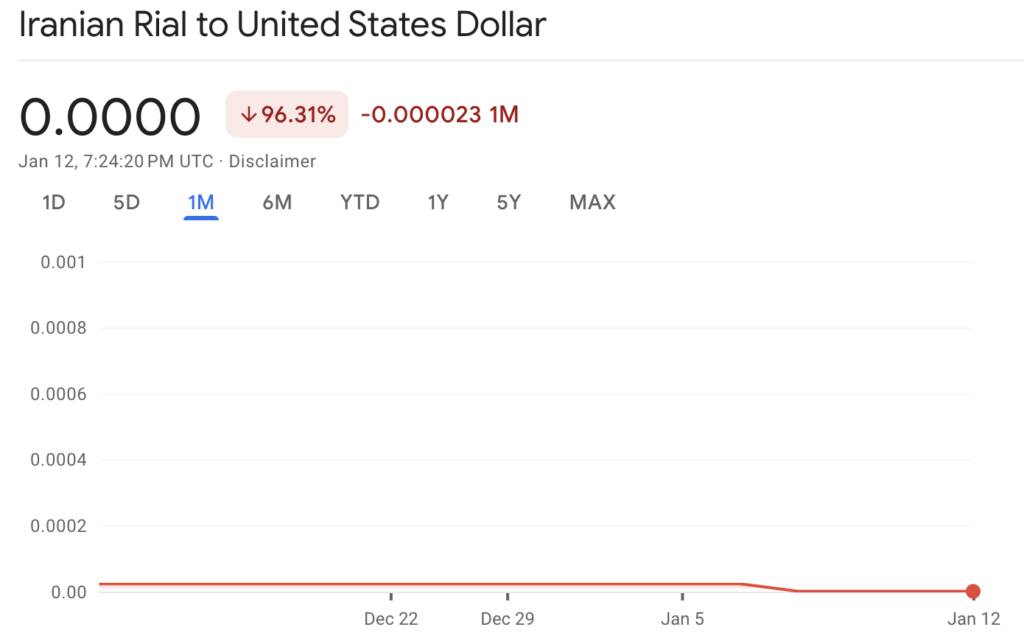
Source: EBC Financial Groups“
Where the Rial Is Trading Today
Iran operates a fragmented foreign exchange system. An official administered rate remains fixed near 42,000 rials per dollar, while selected imports receive subsidised rates far below market levels. In contrast, the open or “street” market—where most private transactions occur—has hovered around 1.45 million rials per dollar.
The vast gap between these rates highlights the scale of distortion. It also cements expectations that further depreciation is likely, a central feature of the ongoing Iran currency crash.
Why Multiple Exchange Rates Fuel Instability
A multi-tier exchange system creates incentives that accelerate decline. Traders often front-run anticipated policy changes, while arbitrage opportunities divert scarce hard currency away from productive use. More damaging still is the loss of confidence: multiple prices for the same dollar signal that authorities are rationing supply, not stabilising it.
That perception feeds into everyday pricing, embedding devaluation into the economy itself.
Key Drivers of the Iranian Rial Collapse
Several forces are converging behind the current Iranian rial collapse. International sanctions continue to restrict access to export revenues and foreign transfers, limiting dollar supply. Persistently high inflation discourages holding cash, while weak growth projections strain public finances.
Policy shifts have also played a role. Late-2025 changes requiring importers to source foreign currency at market rates increased immediate demand for dollars. At the same time, sporadic protests and political uncertainty have added a risk premium, pushing people to shorten their financial horizons and exit the rial more quickly.
Redenomination and the Four-Zero Plan
Iran’s parliament has approved a plan to remove four zeros from the rial, with implementation expected after a lengthy preparation and transition period. Officials frame the move as a way to simplify transactions after years of inflation.
However, redenomination does not change real value. If fundamentals remain weak, prices will simply rise again in the new unit. As a result, the Iran currency crash would persist beneath cleaner-looking banknotes.
What Comes Next for Iran’s Currency
Looking ahead, the most likely path is a gradual “slow bleed,” where inflation stays elevated and the exchange rate weakens in steps. A sharper devaluation remains possible if sanctions intensify or fiscal pressures spike. Redenomination, meanwhile, appears increasingly probable but largely cosmetic.
Ultimately, the rial’s fate depends on restoring credibility through disciplined fiscal policy, monetary restraint, and a clearer exchange-rate regime. Without those shifts, the Iran currency crash will continue to define economic life, regardless of how many zeros appear on the currency.