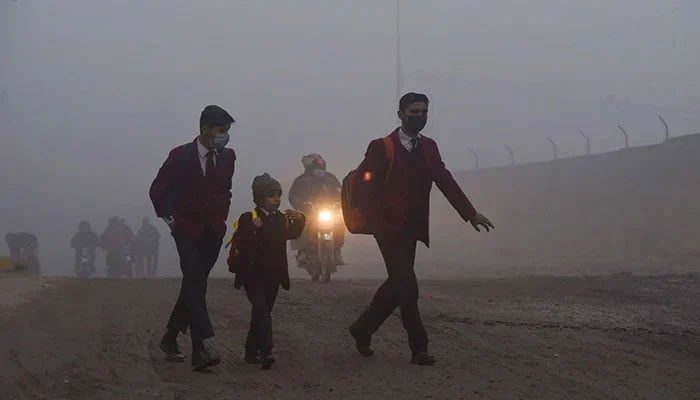
Education Department says new winter schedule aims to protect students’ health
Lahore among world’s most polluted cities as air quality plunges to hazardous levels
As thick smog and winter chills envelop Punjab, the provincial government has announced new school timings to protect students and staff from worsening air quality. The revised schedule, effective Monday, October 27, 2025, will remain in force until April 15, 2026, according to a notification issued by the Punjab Education Department.
New school schedule
Provincial Education Minister Rana Sikandar Hayat said that under the new arrangement, single-shift schools will operate from 8:45am to 1:30pm, and on Fridays until 12:30pm.
For double-shift schools, the first shift will run from 8:45am to 1:30pm, while the second shift will continue from 1:00pm to 4:00pm.
Teachers are required to be on duty from 8:30am to 2:00pm, and until 12:30pm on Fridays. Schools will also open on alternate Saturdays from 9:00am to 12:00 noon.
District CEOs have been given a 15-minute flexibility window to adjust timings according to local climatic and traffic conditions.
Decision driven by rising pollution levels
Officials said the change was prompted by the province’s deteriorating air quality and lower morning temperatures, which together pose health risks for schoolchildren. The Education Department said the adjustment is a precautionary measure to reduce students’ exposure to dense morning smog, which peaks between 6:00am and 8:00am.
Lahore tops global pollution charts
The provincial capital, Lahore, currently ranks among the most polluted cities in the world, with the Air Quality Index (AQI) in several areas crossing 400, placing it firmly in the “hazardous” category.
Neighborhoods such as Ravi Road, Township, and Kot Lakhpat have recorded extreme pollution readings, while cities including Faisalabad and Gujranwala are also under a blanket of toxic haze.
Environmental data shows PM2.5 particulate matter—tiny pollutants capable of reaching deep into the lungs—has exceeded 20 times the WHO’s safe limit.
Health experts raise alarms
Doctors and environmental experts have warned of increasing cases of respiratory illnesses, eye irritation, and throat infections among children. Schools have been advised to limit outdoor assemblies and sports, ensure proper classroom ventilation, and monitor students for any respiratory symptoms.
Parents are being urged to send children wearing protective masks and to limit their outdoor exposure during early hours.
Calls for stronger anti-smog action
Environmental activists have renewed calls for stricter enforcement of anti-pollution laws, including a ban on crop residue burning, industrial emissions control, and traffic reforms to reduce vehicular smoke.
Public health experts have even suggested introducing “smog holidays” if air quality continues to remain dangerously high.
As Punjab battles this persistent environmental crisis, officials hope the new school timing policy will at least shield students from the worst hours of toxic air—until much-needed rain or stronger winds bring relief.